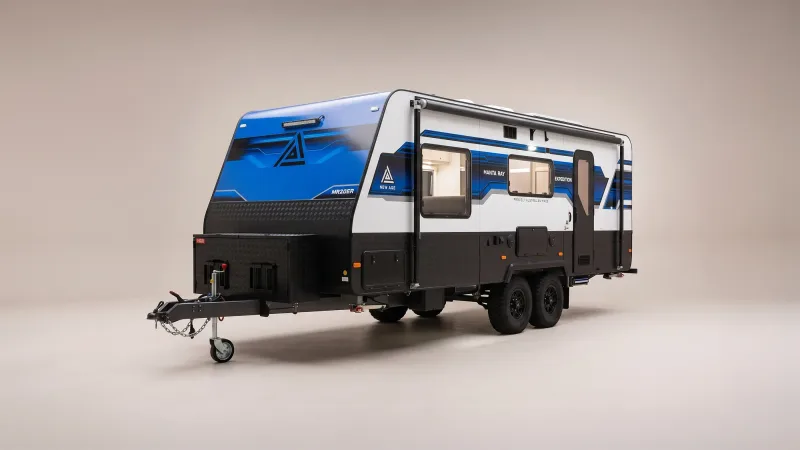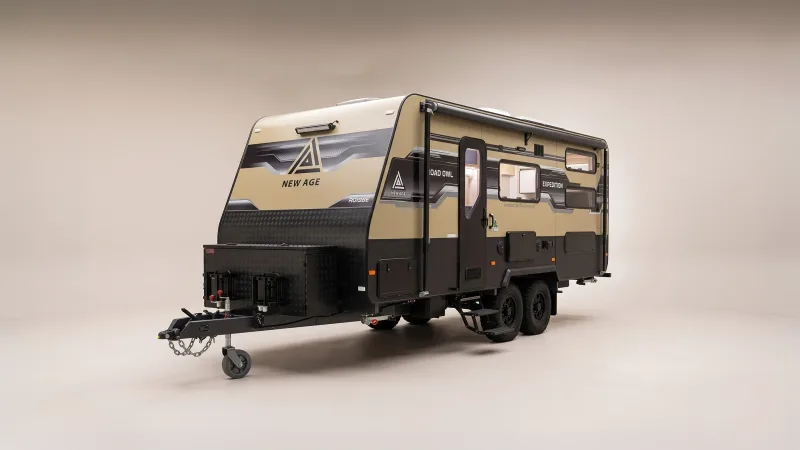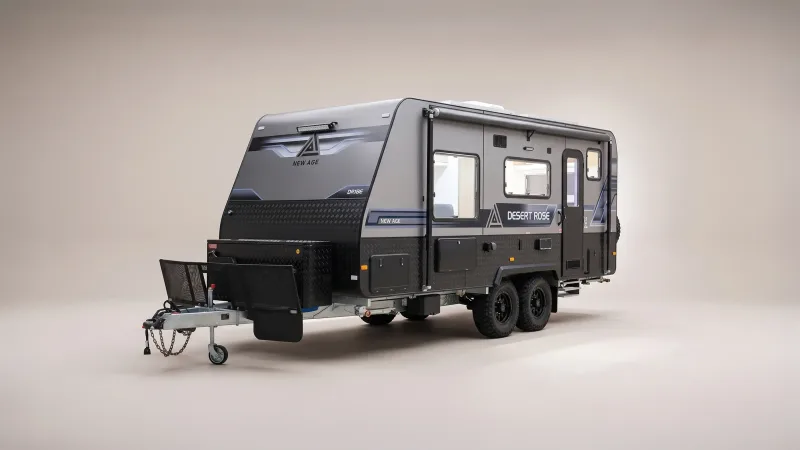
Camping off-grid means running your van with no mains power and no town water. It comes down to three systems working together: a battery bank (usually recharged by solar) for power, enough fresh water on board, and a way to manage waste. Size them to how you camp and you can stay out for days.
Battery bank
Stores the 12-volt power that runs your fridge, lights and pumps. Measured in usable amp-hours (Ah).
Solar
Roof panels that recharge the battery during the day. Measured in watts (W).
Inverter
Turns 12V battery power into 240V for household plugs, sized to what you want to run.
Water & grey tanks
Fresh water you carry, plus a tank to hold used water where it can't go on the ground.
What does off-grid mean for a caravan?
Off-grid (or free-camp) means running your caravan with no mains power and no town water, everything comes from what you carry. Power is stored in a battery bank and topped up by solar; water is in on-board tanks; and waste goes to grey and black tanks.
The more capacity each system has, the longer you last between towns and powered sites. Off-grid capability is really a set of trade-offs, more battery, solar and water mean more freedom, but also more weight and cost. The trick is matching the systems to how you actually camp, not over-building for a trip you'll take once.
Battery & solar: the basics
Your power system is a battery bank that runs your 12-volt gear, fridge, lights, pumps, USB, recharged during the day by roof solar. Capacity is measured in amp-hours (Ah): the more usable Ah you carry and the more solar to refill it, the more nights you can camp off a powered site.
Think of it as a bucket you drain each day and refill with sunlight. If you want to run 240-volt appliances, a coffee machine, a laptop charger. You'll also need an inverter sized to their draw. The goal is simple: put back at least as much as you take out each day, and your battery never runs flat.
Lithium vs AGM: which battery?
Lithium (LiFePO4) gives you far more usable capacity for the weight, charges faster and lasts longer, but costs more upfront. AGM is cheaper but heavier, and you can only safely use about half its rated capacity. For serious off-grid, lithium is usually worth it.
Lithium (LiFePO4)
- Use ~90-100% of rated capacity
- Much lighter for the same usable Ah
- Faster charging, longer lifespan
- Higher upfront cost
AGM / lead-acid
- Safely use only ~50% of capacity
- Heavier for the same usable power
- Slower charge, shorter life
- Lower upfront cost
How much solar do you need?
As a rough guide, aim to replace what you use each day. Many tourers run 200-400 watts of solar to keep a lithium bank topped up in good sun. Shorter winter days, shade and cloud all cut output, so size up if you camp in forests or cooler months.
Panels only make their rated output in ideal conditions, so a realistic day yields well under the sticker figure. If you routinely camp under trees or travel in winter, extra panels (or a portable blanket you can angle at the sun) matter more than one big fixed array. Match the solar to your daily draw, the worked budget below shows how.
Do you need a generator?
A generator is a backup, not a requirement. If your solar and battery are sized to your use, you may never need one. But a small inverter generator (around 2 kVA) covers cloudy stretches, a fast recharge, or running an air-conditioner. Many campers carry one and rarely start it.
Around 2 kVA is the common choice: quiet, light enough to lift, and enough to recharge batteries or run most single appliances. If you free-camp in sunny country with a good lithium-and-solar setup, treat it as insurance. If you camp shaded or need air-con off-grid, it earns its place.
Water & how long it lasts
Fresh water is usually the first thing to run out. Two people using water carefully might get 5-7 days from a 180-litre tank; add a daily shower and it's far less. Carrying more water, or knowing where to refill, is often what really sets your off-grid limit, not power.
With lithium and solar, power can effectively last indefinitely in good sun. So water, not amps, tends to decide when you move on. Managing grey water matters too: many sites require you to hold it rather than drain it on the ground, so a grey tank both keeps you legal and keeps the camp pleasant for the next person.
A worked power budget
Here's a simple daily power budget for a couple's off-grid setup. Figures are indicative, your real draw depends on your fridge, appliances and habits.
| What's running | Typical daily use |
|---|---|
| 12V fridge | ~40 Ah |
| LED lights | ~8 Ah |
| Water pump | ~1 Ah |
| Phones & USB | ~5 Ah |
| Fans / TV | ~10 Ah |
| Daily total | ~65 Ah |
A day like this draws around 65 Ah. A 100 Ah lithium battery covers it with margin, and roughly 300 watts of solar puts that back on a good day. So the setup is self-sustaining in sun. Add air-con or an inverter coffee machine and both numbers climb quickly, which is where more battery, more solar or a generator come in.
What off-grid gear adds to payload
Batteries, extra solar, water and a generator all count toward your payload, and they add up fast. Water alone is 1 kg per litre, and a big lithium bank plus a generator can be 60-80 kg. Factor it in so you don't blow your ATM.
It's easy to spec a van for off-grid and quietly load it past its limit. A full 180-litre water tank is 180 kg on its own, before batteries, panels, a generator and everything else. Read how these weights add to payload so your off-grid kit still leaves you legal on ATM.
New Age vans built for off-grid
New Age's off-road and off-grid-ready models come set up with the battery, solar and water for extended free camping. So the system is engineered as a whole, not bolted on afterwards.
A factory off-grid package means the power, water and charging are sized and installed to work together, with the weight accounted for in the van's ratings. If free camping is the plan, start with the off-road range and pair it with the trips in our free camping in Australia guide.