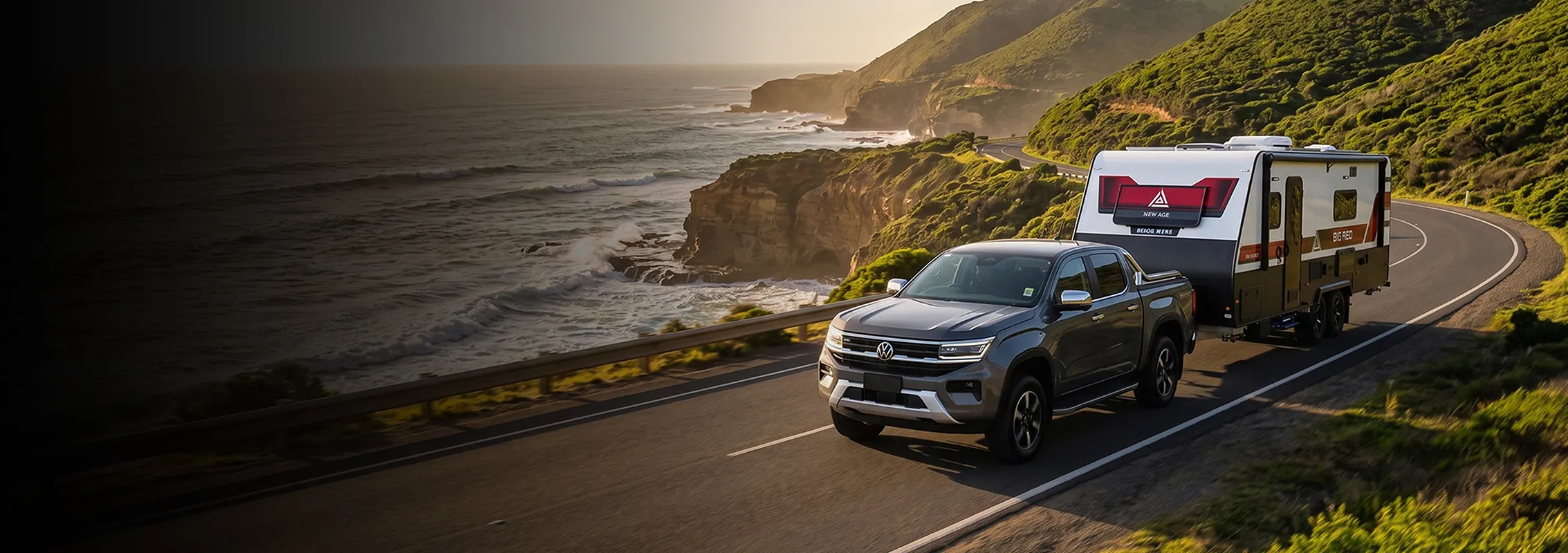
Caravan weight comes down to five numbers: tare (empty weight), payload (what you add), ATM (the fully loaded legal maximum), GTM (the load on its axles) and ball weight (what rests on the tow bar). Get them right and you'll know exactly what your car can legally, safely tow.
Tare
The caravan's empty weight, exactly as built at the factory, before you add a thing.
ATM: Aggregate Trailer Mass
The fully loaded legal maximum, unhitched. Tare plus all your payload.
GTM: Gross Trailer Mass
The weight on the van's own axles while hitched, ATM minus the ball weight.
Ball weight
The downward load the coupling puts on your tow bar, roughly 10% of ATM.
What does ATM (Aggregate Trailer Mass) mean?
ATM is the maximum your fully loaded caravan may legally weigh when it's unhitched, tare plus every kilogram of payload you add. Your tow car's braked towing capacity must sit at or above it.
ATM is the single most important weight on the compliance plate, because it's the one your car is legally matched against. When a spec sheet says a van has a 2,500 kg ATM, that's the ceiling: loaded with water, gas, food, gear and passengers' belongings, the van must never weigh more than that. If your car's braked towing capacity is 2,500 kg or more, the van is a legal match on this measure, though it's not the only number that has to line up (see the tow-vehicle section below).
What is tare weight?
Tare is the caravan's empty weight, exactly as it left the factory, no water in the tanks, no gas bottles filled, no food, clothing or gear. It's the baseline every other weight builds on.
Tare is where marketing and reality can drift apart: a low advertised tare looks appealing, but two vans with the same tare can offer very different amounts of usable payload depending on their ATM. What matters is the gap between tare and ATM, that gap is what you actually get to load. Read tare as a starting point, never as the weight you'll tow.
What is GTM, and how does it differ from ATM?
GTM (Gross Trailer Mass) is the weight carried on the caravan's own axles while it's hitched to your car, the ATM minus the ball weight resting on the tow bar. GTM is always a little less than ATM.
The difference is simply where the weight sits. Unhitched, the whole loaded van rests on its wheels and jockey wheel: that's ATM. Hitched, some of the nose weight transfers onto your car's tow bar as ball weight, so the axles now carry less. That's GTM. GTM matters because it's the figure checked against your caravan's axle rating and, indirectly, your car's rear-axle limit.
What is payload, and what counts toward it?
Payload is everything you add after the factory build, water, gas, food, clothing, tools, bikes and accessories. It's the gap between tare and ATM, and it fills up faster than most people expect.
Water is the quiet payload killer: at 1 kg per litre, a pair of 95-litre tanks is nearly 190 kg before you've packed a single plate. Full gas bottles, an awning, a generator, tools, food and clothing add up quickly. That's why the tare-to-ATM gap is the number to scrutinise, a van with only 300 kg of payload can be full before you've loaded the family.
Counts toward payload
- Fresh, grey & hot water in the tanks
- Full gas bottles
- Food, clothing and personal gear
- Awnings, bikes, generators, tools
- Dealer-fitted and after-market accessories
Already in the tare
- The van's structure and chassis
- Factory-fitted appliances
- Standard fixtures and furniture
- Empty tanks and fittings
- The as-built standard specification
What is ball weight (tow-ball download)?
Ball weight is the downward force the coupling puts on your tow bar, typically around 10% of the loaded ATM. It has to stay under both your tow bar's and your car's rated download limits.
Ball weight is what keeps a rig stable: too little and the van can sway; too much and it overloads the car's rear axle and lifts the steering. Around 10% of ATM is the widely used rule of thumb, but the real figure depends on how you load the van, heavy items packed ahead of the axle push it up, behind the axle pull it down. It's one more reason to weigh the loaded rig rather than trust the plate alone.
GVM, GCM & braked towing capacity, the tow-vehicle side
Three numbers on the car's side decide the match: braked towing capacity (the most it can legally tow), GVM (the loaded car's own limit) and GCM (car and van combined). You can be under every van limit and still be illegal on GCM.
The GCM trap catches a lot of first-time buyers: your car might tow 3,500 kg and carry its own load fine, but the manufacturer's combined limit (GCM) is often less than the two maximums added together. Load the car to its GVM and hitch a van at full ATM, and you can quietly exceed GCM. Working out which van suits your car is its own topic. We cover the full method in what can your car tow?
A worked example
Here's how the numbers stack up on a typical light tourer. The figures below are indicative. Always read your own van's compliance plate and confirm at a weighbridge.
| Measure | Figure | What it tells you |
|---|---|---|
| Tare | 1,980 kg | Empty, as built |
| Payload allowance | 520 kg | The gap you get to load |
| ATM | 2,500 kg | Fully loaded legal max: car's braked capacity must be at least this |
| Ball weight (~10%) | 250 kg | Must be under the car's towball download limit |
| GTM (ATM minus ball) | 2,250 kg | Load on the van's axles when hitched |
To tow this van legally and safely, your car needs a braked towing capacity of at least 2,500 kg, a tow-ball download limit of at least 250 kg, and enough headroom in its GCM to carry both the loaded car and the loaded van together. Tick all three and you've got a legal, stable match.
How to check your real weights
Never trust the plate for your loaded weight, the only true figure comes from a weighbridge with the van packed the way you travel. It's a four-step check.
Read the compliance plate
Find the ATM, GTM and tare stamped on the plate, usually near the door or on the A-frame. These are your legal ceilings.
Load as you'll travel
Fill the water tanks, fit the gas bottles, pack the food, clothes and gear, everything that goes on a real trip.
Head to a public weighbridge
Weigh the van on its own (for ATM and GTM) and then the whole rig hitched (for the combined figure and an indication of ball weight).
Compare against your car's limits
Check every measured weight against your car's braked capacity, towball limit, GVM and GCM. All under? You're good to tow.
Figures on this page are indicative and general in nature, not personal advice. Weights vary by model, layout and options. Always confirm your caravan's loaded weights at a licensed weighbridge and check your vehicle's rated limits with the manufacturer before you tow.
Weights on New Age models
New Age publishes tare, ATM, GTM and ball weight for every model, so you can match a van to your car before you visit a dealer. Lighter, easy-tow options make the sums simpler.
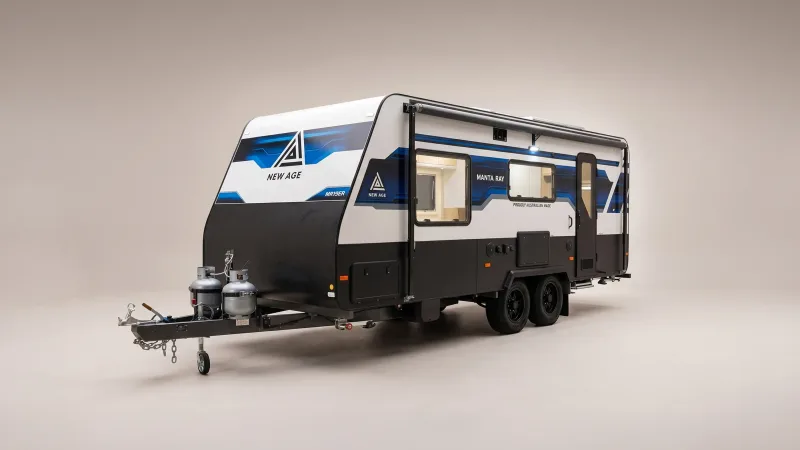
If you're towing with a mid-size SUV or dual-cab ute, start with the lighter end of the range, the Manta Ray's tare and payload make it an easy-tow example worth checking against your car's numbers. When you're ready to compare across the range, you can compare New Age weights model by model and shortlist the vans your car can legally pull.