Three numbers decide what your car can tow: its braked towing capacity (the most it can pull), the caravan's loaded ATM (which has to sit under that), and the ball weight (which has to sit under your towbar's limit). Check your GCM as well and you'll know your match.
Braked towing capacity
The most your car can legally tow with a braked trailer. On the towbar plate and in the handbook.
Caravan ATM
The van's fully loaded maximum weight. Must sit at or under your braked capacity.
Tow-ball limit
The download your towbar can take, roughly 10% of ATM. Ball weight must stay under it.
GCM · combined limit
The most your car and van may weigh together, the number that catches people out.
How to find what your car can tow
Your car's braked towing capacity is the most it can legally tow with a braked trailer. You'll find it on the vehicle's compliance or towbar plate and in the owner's handbook. That single figure is your starting ceiling.
Caravans are always braked trailers, so it's the braked figure you want, not the (much lower) unbraked one. It's a legal maximum set by the vehicle manufacturer, and no towbar, hitch or accessory raises it. Read it first, because it decides which caravans are even in the running before you look at anything else.
Which caravan weight do you compare it to?
Compare your braked capacity to the caravan's loaded ATM, the fully loaded maximum, not the tare and not the GTM. If the ATM sits at or under your braked capacity, it's a match on this measure.
This is where a lot of buyers trip up: they check the tare (empty) weight, which is always well under capacity, and assume they're fine. But you tow the van loaded, so it's the ATM that has to fit. If those terms are new, our caravan weights explained guide defines ATM, tare and GTM in full. This page just uses them.
Tow-ball weight: the limit people miss
Ball weight is the download the coupling puts on your towbar, around 10% of ATM. It has to stay under your car's and towbar's rated download limit, a number that's easy to overlook and easy to exceed.
A 2,500 kg van sits about 250 kg on the ball, and many tow bars and vehicles cap download at 250-350 kg, so it's tighter than it looks. Load heavy gear behind the axle and you can pull the ball weight down out of the safe range, or push it too high loading nose-heavy. It's the number most likely to catch you out on an otherwise legal match.
GCM: the combined-weight trap
GCM (gross combination mass) is the most your car and loaded van may weigh together. It's usually less than the car's own limit plus its full towing capacity. So you can be under each limit yet illegal combined.
Here's the trap: a ute rated to carry its own load and tow 3,500 kg often has a GCM that's a few hundred kilos short of adding those two maximums together. Load the car to its GVM with people, gear and a full tank, then hitch a van at full ATM, and you can quietly blow past GCM. Always do the combined sum. It's the one authorities and insurers check.
A worked tow-match example
Here's the three-number check on a real-world match. Figures are indicative. Always confirm against your own vehicle's plate and a weighbridge.
| The check | The numbers | Result |
|---|---|---|
| Van ATM vs car braked capacity | 2,500 kg vs 3,500 kg | Under |
| Ball weight vs towbar download limit | 250 kg vs 350 kg | Under |
| Car + van vs GCM | 5,800 kg vs 6,000 kg | Under |
Three ticks and it's a legal, stable match. Miss any one, an ATM over capacity, a ball weight over the towbar limit, or a combined weight over GCM, and the rig is non-compliant even if the other two are fine. That's why the tow-match is always three checks, not one.
Do you need a weight distribution hitch?
A weight distribution hitch spreads ball weight across the car's axles and can steady a heavier rig. But it doesn't raise any legal limit. Whether you need one comes down to your car, van and ball weight.
A WDH can restore steering feel and level a rig that's sitting nose-down, which helps stability on longer, heavier vans. What it can't do is let you tow a van that's over your capacity, ball or GCM limits. Treat it as a handling aid, not a way around the numbers, and follow your vehicle maker's guidance on whether one is recommended.
Can a Prado, Ranger, HiLux or LandCruiser tow a caravan?
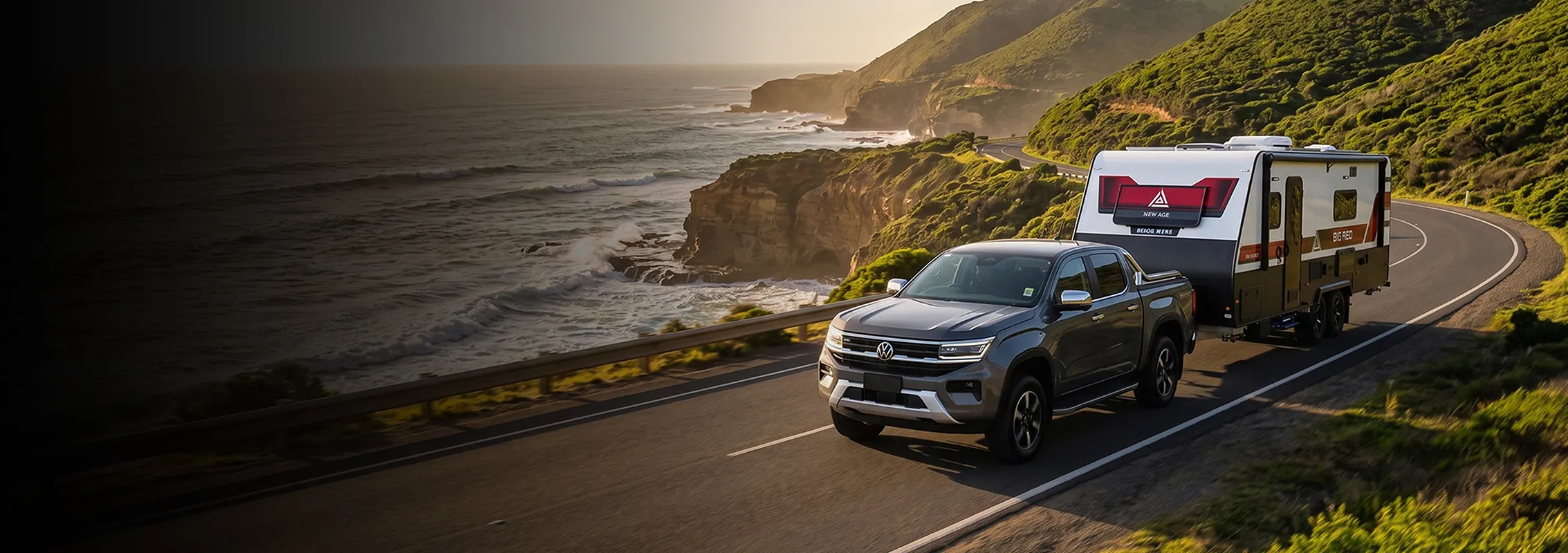
Most popular Australian 4WDs and dual-cab utes are rated to tow 3,000-3,500 kg braked, enough for many caravans. But the rating is only the first check: you still have to clear ball weight and GCM with the car loaded.
| Tow vehicle | Typical braked capacity* |
|---|---|
| Toyota LandCruiser 300 | 3,500 kg |
| Ford Ranger | 3,500 kg |
| Toyota HiLux | 3,500 kg |
| Isuzu D-Max | 3,500 kg |
| Toyota Prado | 3,000 kg |
| Mitsubishi Pajero Sport | 3,100 kg |
*Indicative only. Braked towing capacity varies by variant, model year and build. These published figures are a starting point, not a guarantee of a legal match, a high tow rating still has to be read alongside your ball-weight limit and GCM with the car loaded. Always confirm your exact vehicle's limits on its compliance plate and in the owner's handbook.
New Age vans by how easily they tow
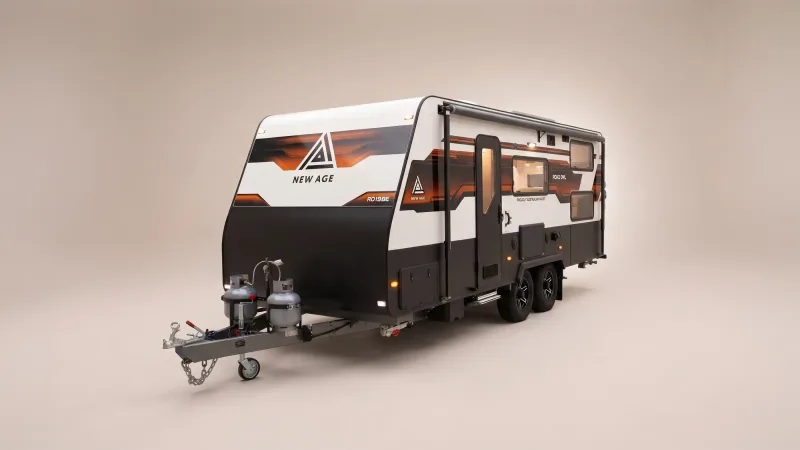
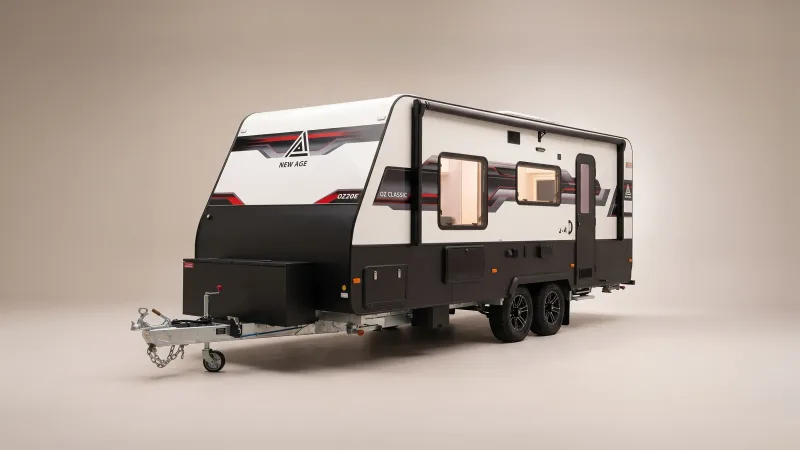
New Age publishes tare, ATM and ball weight for every model, and the lighter vans make the tow-match sums easy. If your car sits at the 3,000-3,500 kg end, start light.
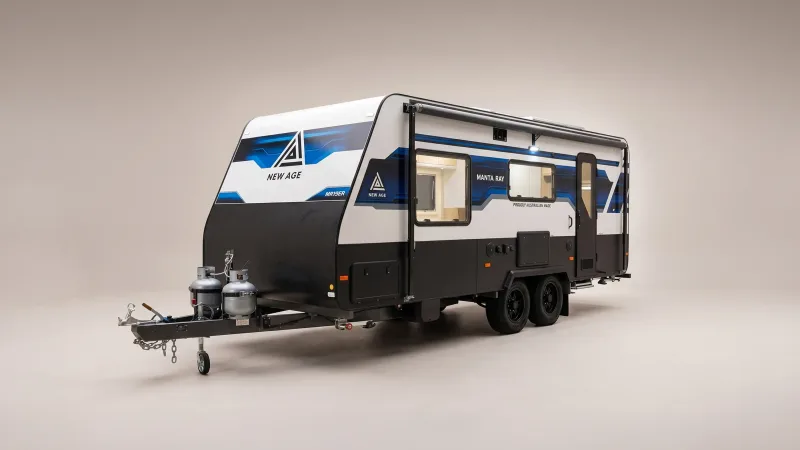
A lighter loaded ATM leaves more headroom on every one of the three checks, which is why easy-tow models suit a wider range of vehicles. The Manta Ray is a good light, easy-tow example to check against your car's numbers, and you can filter the range by tow weight to see every New Age your vehicle can legally pull.