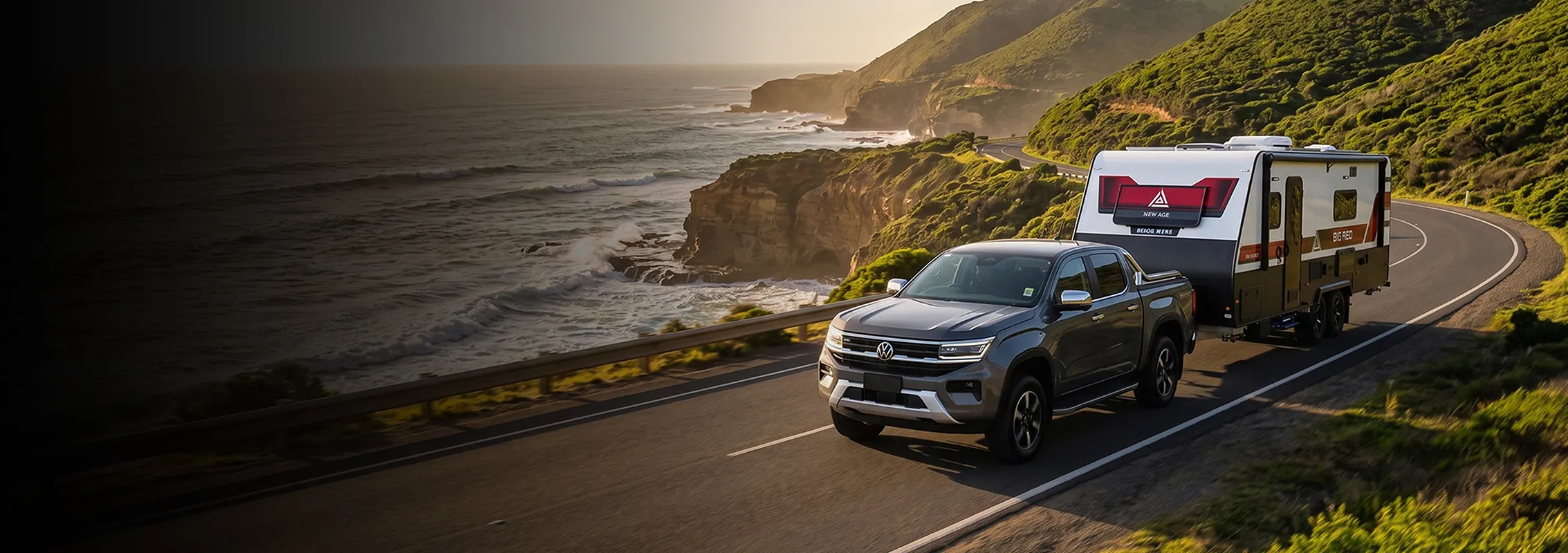
The Great Ocean Road runs 243 km from Torquay to Allansford, and it is an easy tow apart from one 30 km stretch. Give it seven days, base the van in three or four towns, and day trip out with the car. Travel west so the lookouts sit on your side of the road.
How long do you need for the Great Ocean Road with a caravan?
Seven days is the sweet spot with a van in tow. Four days covers the highlights if you keep moving. The road itself is only 243 km, but you will stop constantly, and setting up and packing down a caravan eats an hour at each end of the day.
Day trippers run from Melbourne to the Twelve Apostles and back in one long day. Towing, that is a miserable idea. A caravan turns every lookout into a parking problem, so the trick is to move the van a short distance, set up, and use the tow car for the sightseeing. Three or four bases across a week gives you that, and it keeps most towing legs under two hours.
243 km
Torquay to Allansford
7 days
Comfortable pace with a van
30 km
The tight stretch, Lorne to Apollo Bay
100 km
Melbourne to Torquay
Should you drive it east to west or west to east?
Drive west, from Torquay towards Warrnambool. The ocean then sits on your left, which means most lookouts and pull-off bays are on your side of the road. With a van behind you, not having to cross oncoming traffic to park matters more than the view does.
The other reason is pacing. Heading west, the road opens up as you go. You start on the wide Surf Coast, work through the tight Otway section in the middle of the trip once you have settled into the rig, and finish on the flat, open Shipwreck Coast where parking a van is easy. Doing it in reverse puts the hardest towing on day one.
Where should you base the caravan?
Pick three or four bases: Torquay or Anglesea, Lorne or Apollo Bay, Port Campbell, then Warrnambool or Port Fairy. Each one puts a full day of sightseeing within about 30 minutes of the van, so you tow short and drive light.
| Base | Suits | Worth knowing |
|---|---|---|
| Torquay or Anglesea | Bells Beach, the surf coast, an easy first night out of Melbourne | Wide roads and large parks, the simplest towing on the whole route |
| Aireys Inlet | Split Point Lighthouse, quiet beaches | Small town with limited shops, and it books out over summer |
| Lorne | Erskine Falls, Otway waterfalls, cafes and a supermarket | The busiest town on the road, and fuel is usually dearer here |
| Apollo Bay | Cape Otway, Maits Rest, the Otway rainforest | The best base for the middle of the trip, and the last real town before the road heads inland |
| Port Campbell | Twelve Apostles, Loch Ard Gorge, London Bridge | A tiny town with few sites, so book well ahead |
| Warrnambool or Port Fairy | Whales at Logans Beach, Tower Hill, Bay of Islands | Flat, open and easy towing, and generally better value sites |
What does a seven day Great Ocean Road itinerary look like?
Two nights on the Surf Coast, two in the Otways, two on the Shipwreck Coast, then a run west or home. This is the version that works with a van rather than the one written for a hire car.
Melbourne to Torquay or Anglesea
About 100 km and an easy hour and a half. Set up early, walk out to Bells Beach, and use the afternoon to sort the van rather than chase kilometres.
Anglesea to Lorne
Only about 45 km, so take the whole morning over it. Split Point Lighthouse at Aireys Inlet on the way, then Erskine Falls and Teddys Lookout from Lorne in the car.
Lorne to Apollo Bay
About 45 km and the slowest leg of the week. Leave early, use every passing bay, and stop at Kennett River to look for koalas. Set up in Apollo Bay for two nights.
Otways day trip, van stays put
Cape Otway Lightstation, the Maits Rest rainforest walk and the Otway waterfalls, all in the tow car. Several hinterland roads are signed as unsuitable for caravans, which is another reason to leave the van on site.
Apollo Bay to Port Campbell
About 90 km. The road turns inland through Lavers Hill, climbs into the ranges, then drops back to the coast. Arrive early enough to see the Twelve Apostles at sunset once the tour buses have gone.
The Shipwreck Coast in the car
Loch Ard Gorge, Gibson Steps, the Grotto, London Bridge and the Bay of Islands all sit within about 30 minutes of Port Campbell. The lookouts west of town are quieter than the Apostles and just as good.
Port Campbell to Warrnambool or Port Fairy
About 65 km on flat, open road. Whales off Logans Beach between June and September, and Tower Hill for wildlife. From here it is roughly three and a half hours home on the Princes Highway.
Which stretch is hardest to tow?
The roughly 30 km between Lorne and Apollo Bay. The road narrows, hugs the cliff and turns through tight bends with limited sight lines. Full size vans tow it every day of the week, but it asks for low speed, constant mirror checks and use of every pull-off bay.
Two things make it manageable. Go early in the day, before the traffic and the tour buses build, and avoid Friday afternoons and Sunday evenings if you can. Then commit to pulling over. A queue of cars behind a caravan is where the risky overtakes happen, so use the slow vehicle bays as soon as three or four cars stack up behind you.
What is changing at the Twelve Apostles?
A new visitor centre is being built at the Twelve Apostles precinct, with completion expected around the end of 2026. The Victorian Government has said a booking and fee system will come in when it opens, so check the current arrangements before you plan that day.
In the meantime the visitor car park still takes caravans and motorhomes, though the spaces are limited and they fill quickly. Arriving before about 10am is the usual advice. If you are based at Port Campbell you can skip the problem entirely by driving in at sunrise or sunset in the car, which is when the light is best anyway.
When is the best time to go?
Autumn, from March to May, is the pick for towing. The weather settles, the days are still warm, and once Easter has passed the road is far quieter than in summer. Spring is similar with more wind. Summer is busiest and dearest, and winter is green, wet and very quiet.
| Season | What it is like | Worth knowing |
|---|---|---|
| Autumn, March to May | Settled weather, warm days, calm mornings | The best balance of weather and crowds, though Easter itself is packed |
| Winter, June to August | Cool, green and wet, big southern swells | Whales off Logans Beach at Warrnambool, and the lowest site rates |
| Spring, September to November | Mild and changeable, wildflowers in the Otways | Windy, and school holidays fill the coastal parks |
| Summer, December to February | Warm, dry and very busy | Book months ahead, and expect slow going through Lorne |
What does your van and car need for this trip?
Nothing exotic. This is sealed road, powered site touring, so a standard on road van is the right tool for it. What matters is that your rig sits comfortably inside its limits and is short enough for the parks you have booked.
Tow match confirmed: your car's braked capacity against the van's ATM, and ball weight against the towbar rating
Loaded weights checked at a licensed weighbridge rather than estimated from a brochure
Overall rig length known, because many parks on this route take rigs to about 8 m and the smaller bush campgrounds take none
Brakes and tyres checked on both car and van, since the Otway descents are long
Sites booked ahead, especially Lorne, Apollo Bay and Port Campbell
Fuel topped up at Torquay, Apollo Bay or Warrnambool, which are usually cheaper than Lorne and Port Campbell
Warm layers and a rain jacket whatever the month, because this coast is exposed
Dawn and dusk towing avoided through the Otways, where wildlife on the road is common
If any of that is new to you, start with what can your car tow and caravan weights explained. If this trip is the warm up for something bigger, planning the first leg of the Big Lap is the next read.
Which New Age suits the Great Ocean Road?
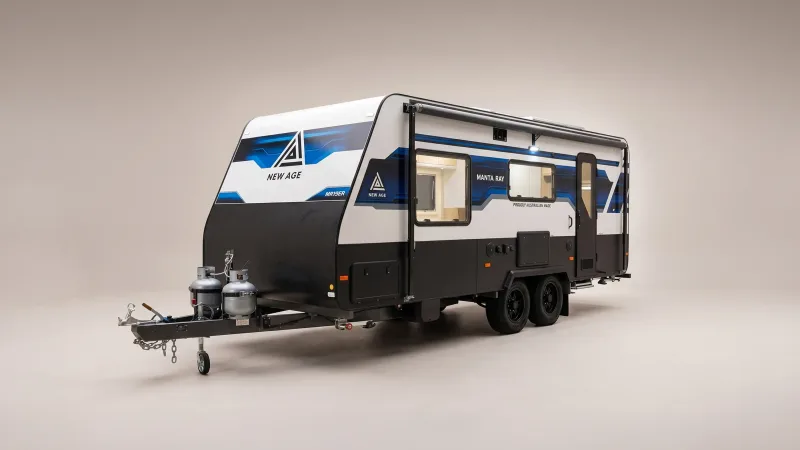
An on road couples van is the right shape for this trip. You are on sealed road the whole way, moving short distances, and you want something light enough to be relaxed on the Otway bends. The Manta Ray is built for exactly that.
The Manta Ray runs from 15 ft to 20 ft across five layouts, all set up for two. Indicative figures across the range are a tare of about 1,900 to 2,260 kg, an ATM of about 2,400 to 2,960 kg, payload of about 500 to 700 kg and ball weight of about 120 to 155 kg. The lighter end sits inside what a lot of dual cab utes and large SUVs already tow, which is why it is often the easiest New Age to match to the car already in your driveway.
15 to 20 ft
Length range
2,400 to 2,960 kg
ATM range, indicative
500 to 700 kg
Payload range, indicative
120 to 155 kg
Ball weight range, indicative
For a trip like this the practical wins are an ensuite you do not have to walk to in an Otway shower, 110 L of fresh water and 400 W of solar for any night you are not on power, and a footprint that fits the smaller coastal parks. If your plans later stretch to gravel and remote tracks, the Manta Ray Expedition covers similar layouts in a full off road build.
Layouts, weights and specifications vary by model and build, so check a specific van's plated ATM and ball weight against your car before you commit. Which New Age is right for me narrows the shortlist, and caravan layouts explained covers the couples floorplans.
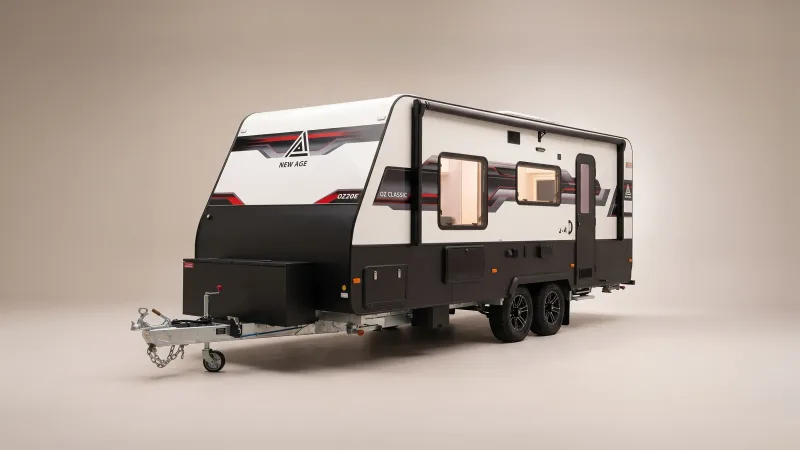

Start the trip right with a walk-through at New Age Melbourne before you roll onto the coast.